
What happens when brilliant research meets the right support?
For researchers, the path from lab to impact isn’t always clear. Future Worlds works with university researchers of all levels, helping them explore what’s possible long before a company exists. This event, in collaboration with Future Worlds, is for anyone in Scotland working with AI, whether it’s your core focus or a tool you’re using to push boundaries.
For this Thursday Gathering, we’re bringing together researchers, founders, and ecosystem connectors for an evening built around inspiration and possibility. Expect lightning talks, showcases, and a welcoming space to ask: what if?
Whether you’re a PhD student, a postdoc, or a professor – if you’re building something with AI and want to explore where it could lead, come along and be part of the conversation.
To find out more about Future Worlds, click the link below:

Join us for an evening of conversation, collaboration, and connection with innovators, founders, creatives, and curious minds from across the community.
Designed as a relaxed and welcoming space, this is an opportunity to exchange ideas, meet potential collaborators, and engage with new perspectives in an open and informal environment.
Whether you’re looking to grow your network, explore new opportunities, or simply have interesting conversations, there’s a place for you here.
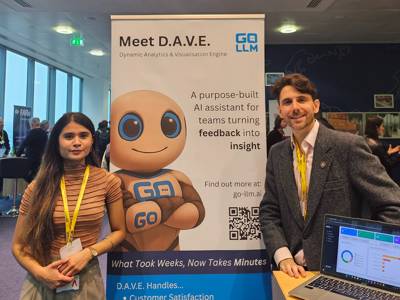
GoLLM is an Edinburgh-based AI company helping organisations maintain a competitive edge in the AI age by turning feedback data into timely, trusted insight. Its platform, D.A.V.E. - Dynamic Analytics Visualisation Engine - analyses survey, interview, conversation and other feedback data to produce reliable, executive-ready reporting in minutes. Built for Customer, People, and Insights teams, D.A.V.E. reduces analyst time, surfaces risks and opportunities sooner, and frees skilled teams to focus on higher-value work. GoLLM is grant-backed and built with governance and auditability by design.
Drop in to connect with founder Daniel Shorr, ask questions, and discover more about the ideas and technology behind the platform.
Could you identify the most expensive chocolate using taste alone?
As we explore the future of AI in Scotland, this session invites us to think about how humans make decisions, recognise patterns, and judge quality - and how those same questions shape the AI systems increasingly influencing our world.
Join us for a fun and interactive blind tasting challenge where you’ll sample five different 85% dark chocolates from a range of brands and price points. Compare flavours, textures, and aromas, rank your favourites, and see if you can correctly guess which chocolates are budget buys and which are premium selections.
Will the most expensive chocolate really taste the best? Can you spot subtle differences in quality and flavour - or will your expectations surprise you?
Score your guesses, compare results with others, and see who comes closest to getting them all right!

How does AI turn instructions into results?
In this hands-on, interactive session we’ll be using AI Tinkerers Cards to explore one of the core ideas behind modern AI: how different inputs shape different outputs.
By experimenting with prompts, constraints, and context, you’ll see how small changes can dramatically shift what an AI produces.
You’ll be able to explore different combinations of inputs and see how they influence and transform outputs in real time, uncovering how AI systems interpret and reshape information.
Come ready to play, test, and tinker with how AI really works underneath the surface.

Welcome from Venture Café Edinburgh Director, Claudia Cavalluzzo and the event's sponsor, Future Worlds.

Onyinye Igbokwe (Head of Regional Partnerships, CodeBase) will give an update on a major new partnership between CodeBase and CoreWeave. She'll explain what it means for Scotland's AI startups and how it directly addresses the compute gap, one of the biggest barriers early‑stage founders face when building and scaling AI models.

As global warming accelerates, Solar Radiation Management (SRM) is increasingly considered as a tool to mitigate near-term climate risks. To this end, assessing the risks of SRM is crucial, but the assessment is hindered by the high computational cost of traditional Earth System Models (ESMs). We work on a novel framework that leverages deep learning to accelerate the assessment of SRM impacts, specifically focusing on stratospheric aerosol injection and marine cloud brightening.
By adapting NeuralGCM—a hybrid atmospheric model combining differentiable physics with machine learning—we aim to construct a forecast tool which provides diverse spatial and temporal scales at a fraction of the traditional computational cost. To ensure the reliability of these models for policy-level decision-making, we integrate domain-specific XAI methods that allow experts to interpret model behaviour, verify physical consistency, and quantify regional uncertainties. This toolbox provides a transparent and scalable pathway for evaluating climate interventions, contributing to a more informed and safer global climate strategy.

Train Forge is building an autonomous infrastructure agent that aims to make AI model training as easy as using ChatGPT. In his talk, Co-Founder Muhammad Bilal will share why so many AI projects stall before production, how infrastructure friction raises the “cost of curiosity,” and how Train Forge helps startups and businesses fine-tune, evaluate, and deploy open-source AI models without needing to manage complex DevOps work themselves.

From chatbots to voice assistants, the AI most of us interact with every day is just a sliver of what’s being explored in university labs. Behind closed doors, researchers are working on ideas and applications that are hugely different from today’s consumer AI. To help us understand what's coming next, Eyad Elyan, Professor of Machine Learning and Computer Vision at Robert Gordon University, takes us beyond a consumer interface to explore what’s really coming next in the world of AI. It’s a glimpse of the future most of us haven’t seen yet.





What happens when brilliant research meets the right support?
For researchers, the path from lab to impact isn’t always clear. Future Worlds works with university researchers of all levels, helping them explore what’s possible long before a company exists. This event, in collaboration with Future Worlds, is for anyone in Scotland working with AI, whether it’s your core focus or a tool you’re using to push boundaries.
For this Thursday Gathering, we’re bringing together researchers, founders, and ecosystem connectors for an evening built around inspiration and possibility. Expect lightning talks, showcases, and a welcoming space to ask: what if?
Whether you’re a PhD student, a postdoc, or a professor – if you’re building something with AI and want to explore where it could lead, come along and be part of the conversation.
To find out more about Future Worlds, click the link below:
Join us for an evening of conversation, collaboration, and connection with innovators, founders, creatives, and curious minds from across the community.
Designed as a relaxed and welcoming space, this is an opportunity to exchange ideas, meet potential collaborators, and engage with new perspectives in an open and informal environment.
Whether you’re looking to grow your network, explore new opportunities, or simply have interesting conversations, there’s a place for you here.
GoLLM is an Edinburgh-based AI company helping organisations maintain a competitive edge in the AI age by turning feedback data into timely, trusted insight. Its platform, D.A.V.E. - Dynamic Analytics Visualisation Engine - analyses survey, interview, conversation and other feedback data to produce reliable, executive-ready reporting in minutes. Built for Customer, People, and Insights teams, D.A.V.E. reduces analyst time, surfaces risks and opportunities sooner, and frees skilled teams to focus on higher-value work. GoLLM is grant-backed and built with governance and auditability by design.
Drop in to connect with founder Daniel Shorr, ask questions, and discover more about the ideas and technology behind the platform.
Could you identify the most expensive chocolate using taste alone?
As we explore the future of AI in Scotland, this session invites us to think about how humans make decisions, recognise patterns, and judge quality - and how those same questions shape the AI systems increasingly influencing our world.
Join us for a fun and interactive blind tasting challenge where you’ll sample five different 85% dark chocolates from a range of brands and price points. Compare flavours, textures, and aromas, rank your favourites, and see if you can correctly guess which chocolates are budget buys and which are premium selections.
Will the most expensive chocolate really taste the best? Can you spot subtle differences in quality and flavour - or will your expectations surprise you?
Score your guesses, compare results with others, and see who comes closest to getting them all right!
How does AI turn instructions into results?
In this hands-on, interactive session we’ll be using AI Tinkerers Cards to explore one of the core ideas behind modern AI: how different inputs shape different outputs.
By experimenting with prompts, constraints, and context, you’ll see how small changes can dramatically shift what an AI produces.
You’ll be able to explore different combinations of inputs and see how they influence and transform outputs in real time, uncovering how AI systems interpret and reshape information.
Come ready to play, test, and tinker with how AI really works underneath the surface.
Welcome from Venture Café Edinburgh Director, Claudia Cavalluzzo and the event's sponsor, Future Worlds.
Onyinye Igbokwe (Head of Regional Partnerships, CodeBase) will give an update on a major new partnership between CodeBase and CoreWeave. She'll explain what it means for Scotland's AI startups and how it directly addresses the compute gap, one of the biggest barriers early‑stage founders face when building and scaling AI models.
As global warming accelerates, Solar Radiation Management (SRM) is increasingly considered as a tool to mitigate near-term climate risks. To this end, assessing the risks of SRM is crucial, but the assessment is hindered by the high computational cost of traditional Earth System Models (ESMs). We work on a novel framework that leverages deep learning to accelerate the assessment of SRM impacts, specifically focusing on stratospheric aerosol injection and marine cloud brightening.
By adapting NeuralGCM—a hybrid atmospheric model combining differentiable physics with machine learning—we aim to construct a forecast tool which provides diverse spatial and temporal scales at a fraction of the traditional computational cost. To ensure the reliability of these models for policy-level decision-making, we integrate domain-specific XAI methods that allow experts to interpret model behaviour, verify physical consistency, and quantify regional uncertainties. This toolbox provides a transparent and scalable pathway for evaluating climate interventions, contributing to a more informed and safer global climate strategy.
Train Forge is building an autonomous infrastructure agent that aims to make AI model training as easy as using ChatGPT. In his talk, Co-Founder Muhammad Bilal will share why so many AI projects stall before production, how infrastructure friction raises the “cost of curiosity,” and how Train Forge helps startups and businesses fine-tune, evaluate, and deploy open-source AI models without needing to manage complex DevOps work themselves.
From chatbots to voice assistants, the AI most of us interact with every day is just a sliver of what’s being explored in university labs. Behind closed doors, researchers are working on ideas and applications that are hugely different from today’s consumer AI. To help us understand what's coming next, Eyad Elyan, Professor of Machine Learning and Computer Vision at Robert Gordon University, takes us beyond a consumer interface to explore what’s really coming next in the world of AI. It’s a glimpse of the future most of us haven’t seen yet.